The battery passport arriving in February is not for the battery in your laptop.
It covers e-bike, industrial and electric vehicle batteries, and even there the dismantling information a repairer would want sits in the tier you need a legitimate interest to read.
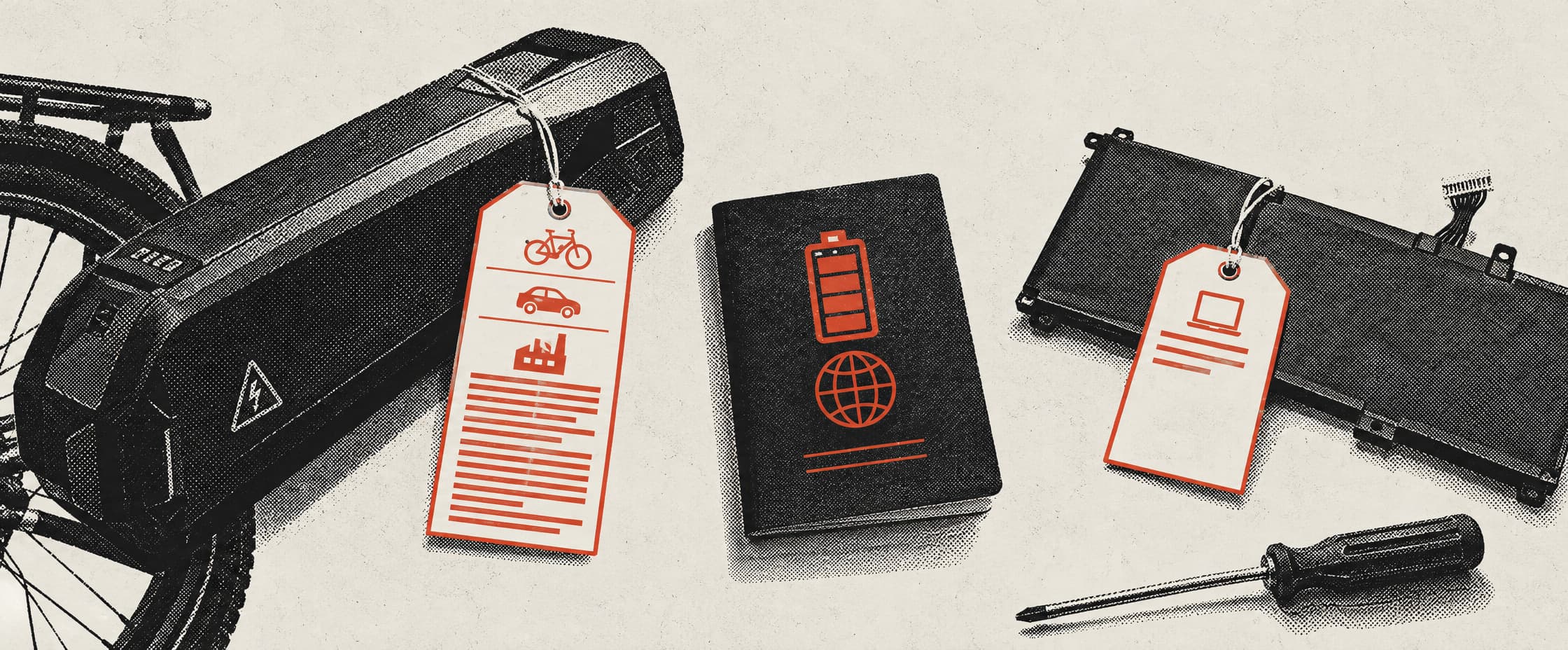
My laptop battery is a sealed pouch about the size of a paperback, and in February it will be covered by a regulation that gives it a label. Not a passport. The passport is for something else.
This is worth getting straight because the two have been run together for about two years now, and a lot of people are waiting for a document that is not coming to them.
What is decided
Article 77(1) of the batteries regulation, in full, because the scope is the whole story:
From 18 February 2027 each LMT battery, each industrial battery with a capacity greater than 2 kWh and each electric vehicle battery placed on the market or put into service shall have an electronic record ('battery passport').
Three categories. An LMT battery is defined elsewhere in the same regulation as a sealed battery of 25 kg or less for the traction of wheeled vehicles — an e-bike, an e-scooter, an L-category moped. An industrial battery over 2 kWh is a rack in a building. An electric vehicle battery is the obvious thing.
A laptop battery is none of those. It is a portable battery, which the regulation defines as sealed, 5 kg or less, not designed specifically for industrial use, and neither an EV, LMT nor SLI battery. The phone in your pocket, the battery in your drill, the cell in your laptop: portable, all three, and outside Article 77.
So in February the e-bike downstairs gets an electronic record with a unique identity and a state of health. The laptop on the desk gets a label.
The label is not nothing
It is worth knowing what you do get, because it is more than the current sticker.
Annex VI lists what has to be on a battery's label: the manufacturer, the category, the place of manufacture, the date of manufacture to the month and year, the weight, the capacity, the chemistry, the hazardous substances other than mercury, cadmium and lead, the usable extinguishing agent, and the critical raw materials present above 0,1 % by weight. Part C adds a QR code, which has to be in high contrast and readable by an ordinary phone.
Date of manufacture on every cell is genuinely useful to somebody buying a replacement, because it is the one fact a listing never gives you and the one that decides whether a part has sat in a warehouse for three years. I will take it.
But a label is a statement about a model at the point of sale. A passport is a record about an individual unit that goes on being updated, which is what makes it interesting for a thing you intend to keep.
Even where the passport exists, the useful half is behind a door
Article 77(2) splits the contents three ways: information for the general public, information for notified bodies, market surveillance authorities and the Commission, and information for any person with a legitimate interest.
The third tier is the one a repair shop cares about. The regulation says what that access is for, and it is specific: dismantling of the battery, including the safety measures to be taken during dismantling, and the detailed composition of the battery model, where that is essential to let repairers, remanufacturers, second-life operators and recyclers do their work.
Read that twice. The composition and the dismantling procedure — the two things you need to open a pack safely and reuse the cells — are not in the public tier. They are available to a repairer who can establish a legitimate interest. Which is a defensible answer to a real safety problem, and it is also a gate, and whether it is a low gate or a high one depends entirely on the registration mechanism that sits behind it.
That mechanism is not in Article 77. It is the thing I would be reading if I ran a repair business, and I cannot tell you today what it looks like.
Battery passportE-bike, industrial over 2 kWh, EV
Portable batteriesLaptop, phone, power tool
Repairability measureHorizontal, with a score
ICT product passportThe delegated act, not the duty
What is announced, which is not the same thing
The digital product passport for electronics is real as a programme and soft as a date.
The Commission's own FAQ gives an indicative timeline for the delegated acts that would introduce it: iron and steel in 2026, energy-related products across 2026 to 2029, textiles, tyres and aluminium in 2027, furniture in 2028, and then — the row that matters here — "2029 – Mattresses and ICT products".
Two things about that row. It is indicative; the Commission says so in the sentence introducing the list. And it is the date of a delegated act, not of an obligation: adopting the act starts a process that ends in requirements some time after it, so a reader treating 2029 as the year their laptop acquires a passport is out by however long that tail turns out to be.
Then the sentence I would put on the wall, which is also the Commission's:
inclusion of a product group in the Working Plan does not automatically mean that the use of a DPP among these products is mandatory
That is an unusually honest piece of drafting and it settles the question. The ICT passport is not scheduled. It is listed.
The nearer thing for anyone who cares about keeping hardware is reported to be a horizontal repairability measure with a scoring system, in the first half of 2027. I have not read the working plan and I am taking that on report, so treat it as a direction rather than a date — but a repairability score on a laptop would change more buying behaviour in its first year than a passport would in five, because a score is a number on a shelf edge and a passport is a URL.
What I would do with this
Nothing, which is the honest answer, and that is the point of writing it down.
If you were deferring a laptop purchase until the passport arrived, stop deferring: it is not coming to that product on any published date. If you buy e-bikes for a business, February is real and the record you will get is per-unit, which is the first time anyone has been able to check a used pack's history against something other than the seller.
And if you buy replacement cells, the date of manufacture on the label from February is the thing to look at. Not the passport you were promised. The month stamped on the thing in your hand.
Written from
Primary The document itself. Claims in this piece rest only on these.
- Regulation (EU) 2023/1542 concerning batteries and waste batteriesRead directly on EUR-Lex for this piece, not through a summary, because every secondary account of it seen while reporting this described the scope more loosely than the text does. Source for Article 77(1), quoted in full, including the three categories and the date; for Article 77(2) and its three tiers of access, and for the purposes attached to the third tier — dismantling, safety measures during dismantling and detailed composition, for repairers, remanufacturers, second-life operators and recyclers; for the definition of 'portable battery' as sealed, 5 kg or less, not designed specifically for industrial use and neither an electric vehicle, LMT nor SLI battery; for the definition of 'LMT battery' as sealed, 25 kg or less and designed for the traction of wheeled vehicles; and for Annex VI Parts A and C, the label contents and the QR code requirement.
- Digital Product Passport, frequently asked questions, question 5Read for this piece. Source for the indicative timeline of delegated acts quoted in the body — iron and steel 2026, energy-related products 2026 to 2029, textiles, tyres and aluminium 2027, furniture 2028, mattresses and ICT products 2029 — for the Commission's own description of it as an indicative timeline, and for the sentence that inclusion of a product group in the working plan does not automatically mean that a DPP is mandatory for those products. That sentence is the reason this piece treats 2029 as a plan rather than a date.
- Whether any instrument will extend a passport to portable batteries, and whenNot established, and the body does not say never. Article 77 as it stands excludes portable batteries by the definition at Article 3, and nothing found while reporting this schedules an extension. That is a statement about the text today and about a search, not a prediction: a regulation can be amended, and a reader planning past 2029 should check rather than take this page's word for it.
Reporting Attributed, not relied on. Where the reporting is the fact, it says so.
- The first ESPR and energy labelling working plan, and the horizontal repairability measureAttributed and not relied on. The working plan is reported as adopted on 16 April 2025, running 2025 to 2030 with a mid-term review in 2028, and as bringing electronics in through horizontal measures rather than as a product group of their own; a JRC preparatory study is reported as listing a horizontal repairability measure including a scoring system for the first half of 2027. Neither the working plan nor the study was opened by this desk. The body says what they are reported to say and rests nothing on it, because the argument here is about what the battery regulation does and what the Commission's own FAQ schedules, both of which were read.