Wi-Fi 8 routers are taking pre-orders. The standard they are built on is scheduled for approval in May 2028.
The IEEE amendment is drawn for carrier frequencies up to 7250 MHz. Europe's unlicensed share of 6 GHz stops at 6425, and the Commission's own advisers have recommended that most of the band above it goes to mobile.
Draft, not yet edited. Written by Joris Feenstra, and not yet through the desk: nothing here has been checked against the sources listed at the foot of the page. Do not act on it.
TP-Link's global launch event is today, and the Archer 8 Ultra goes up for pre-order in some regions after it. The company's own announcement, dated 31 August, calls it a tri-band Wi-Fi 8 router doing up to 19 Gbps of aggregate wireless and 10 Gbps wired, and describes its foundation in three words: the upcoming IEEE 802.11bn standard.
Upcoming is the correct word, and it is doing a lot of work.
The standard has a timetable, and it ends in 2028
The task group that writes 802.11bn publishes its own schedule. Draft 2.0 went to a working group letter ballot in July 2026, two months later than the group had projected. Draft 3.0 is pencilled for January 2027, the first standards association ballot for May 2027, working group and 802 approval for March 2028, and RevCom and SASB approval for May 2028. That last one is the date the standard exists.
So a router on pre-order today is built against a draft with two more ballots to survive. This is not a scandal and it is not new — Wi-Fi 7 hardware was on shelves well before 802.11be was ratified, and Wi-Fi 6 before that. It does mean that the part of the feature list the silicon cannot already do in hardware is a firmware promise, and TP-Link's release makes no firmware commitment at all. It says nothing about what happens if the draft moves.
The Wi-Fi Alliance, for its part, already has a page describing Wi-Fi 8 as "the latest generation of Wi-Fi". It does not mention 802.11bn, does not announce a certification programme, and gives no date.Certification is what normally turns a draft into an interoperability guarantee you can hold a manufacturer to. Until there is a programme, "Wi-Fi 8" on a box is the manufacturer's own word.
What the amendment is actually for is reliability, which does not photograph well
The project's stated objectives are three modes: one capable of increasing throughput by 25 % at a specified signal-to-interference-and-noise ratio, one reducing latency by 25 % at the 95th percentile, and one reducing MPDU loss by 25 %. Lower access-point power consumption and better peer-to-peer operation are named as further goals.
Read that list again and notice what is not on it. There is no new peak rate, no new modulation headline, and no new band. The letters UHR stand for ultra high reliability, and the numbers are about the bad end of the distribution — the 95th percentile, the lost frames — rather than the number on the box. For somebody who keeps a router for five years, that is the better kind of improvement. It is also the kind that no retail page can show you.
Europe has room for one 320 MHz channel, and that is the whole of it
Here is the part that decides how much of this you will see.
The amendment's own scope line says it applies to carrier frequency operation between 1 GHz and 7.250 GHz. The silicon, in other words, is drawn for a ceiling of 7250 MHz.
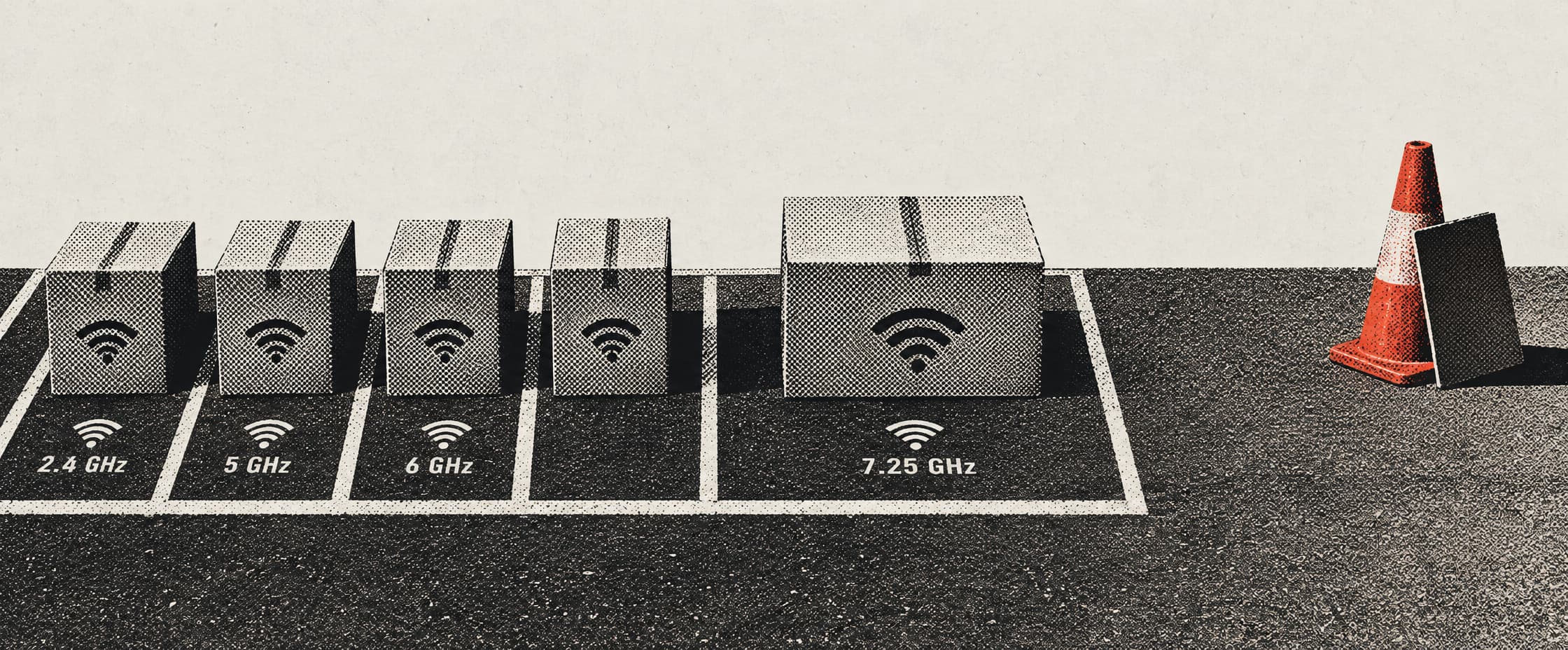
Europe's unlicensed allocation stops a long way below that. By the Commission's own count, in its December 2024 mandate to CEPT, 1018.5 MHz of mid-band spectrum is harmonised across the Union for wireless access systems: the 2.4 GHz band, two stretches of 5 GHz, and 5945 to 6425 MHz under Implementing Decision (EU) 2021/1067. The same mandate states what that buys you in the units that matter: up to five 160 MHz channels, and one 320 MHz channel.
One. The widest channel Wi-Fi 7 introduced, and Europe has room for a single instance of it, with 160 MHz left over.
The specification is drawn to 7250 MHz. The regulation stops at 6425.
The arithmetic on the band above is worth doing yourself, because nobody prints it. The lower 6 GHz band, 5945 to 6425, is 480 MHz wide. The first 160 MHz above it, 6425 to 6585, would make the run contiguous at 640 MHz — which is two 320 MHz channels instead of one. That 160 MHz is the difference between one wide channel and two, and it is the exact slice that Europe has decided not to decide.
What has been recommended is not what has been decided
On 12 November 2025 the Radio Spectrum Policy Group, which advises the Commission, adopted its opinion on the upper 6 GHz band, 6425 to 7125 MHz. It recommends a prioritised use of 6585 to 7125 MHz — 540 MHz — for mobile. It recommends that the remaining 160 MHz, 6425 to 6585, be held as a guard band, with a block edge mask on mobile above it, to protect the Wi-Fi already operating below. Its words on that slice are unambiguous: Member States "will not release the band neither for MFCN nor for WAS/RLAN".
Two things about that document deserve saying plainly. It is advice, not law. And its own assessment of demand is that the RSPG "sees no immediate significant spectrum needs" for either mobile or Wi-Fi in Europe, because the lower 6 GHz band and the existing mobile bands are not yet full. The body that found no immediate need for the band recommended, in the same chapter, which of the two industries should have most of it.
Who decides the rest, and when
| Question | Decided by | When |
|---|---|---|
| Whether 802.11bn exists as a standard | IEEE 802 RevCom and SASB | Scheduled May 2028 |
| Whether "Wi-Fi 8" means anything testable | Wi-Fi Alliance certification | No programme announced |
| Whether mobile and Wi-Fi can share 6585-7125 MHz at all | CEPT, under the 2024 mandate | Task 2 final results due November 2026; Task 3, the technical conditions, July 2027 |
| Who gets the frozen 160 MHz at 6425-6585 MHz | WRC-27 first, then a follow-up RSPG opinion | Conference runs 18 October to 12 November 2027, Shanghai |
| Whether unlicensed use of the mobile segment is allowed in your country | Each Member State, and some want it licensed | After CEPT reports |
| Whether any of it becomes EU law | Commission implementing decision | None adopted that I could find |
The chain of contingency in row four is the one to keep. The RSPG's position is that if WRC-27 identifies 7125 to 7250 MHz for mobile, there is a strong case for giving the 160 MHz to Wi-Fi; if WRC-27 does not, there is a strong case for giving it to mobile. Which is to say that the second wide channel in a European home depends on a treaty conference in Shanghai deciding something about a different band entirely. The United Kingdom is running its own process on 6 GHz sharing, which I have not read and about which this piece says nothing.
What this does to the box you buy this autumn
Nothing dramatic, which is the honest answer.
A Wi-Fi 8 router bought this year will work on the bands Europe has now, and those bands are protected: Article 3 of Decision (EU) 2021/1067 tells Member States not to adopt conditions for new applications that unduly restrict the continued use of Wi-Fi in 5945 to 6425 MHz, and the RSPG's guard band recommendation is built around honouring that. The lower 6 GHz band is not being taken away from you.
What you will not get, on any timetable anybody has published, is a second 320 MHz channel. TP-Link's announcement calls the Archer 8 Ultra tri-band and does not say which three bands or what channel widths, and I found no figure for either in it. If the third band is 6 GHz, it is the lower half, and the hardware is already at the European ceiling on day one.
That is worth knowing before the pre-order page opens, and it is not a reason to wait. The reliability work is real and it arrives in firmware and silicon regardless of how the band fight ends. Just do not buy a router this autumn on the expectation that a regulator will widen it later.
The next thing that actually happens is not a product. CEPT's final results on whether mobile and Wi-Fi can share the upper 6 GHz band at all are due in November 2026, six weeks from now, and everything in the table above sits downstream of them.
Written from
Primary The document itself. Claims in this piece rest only on these.
- IEEE P802.11 Task Group BN (UHR) status updateThe task group's own public status page, read for this piece. Source for every date in the timetable printed here: PAR approved July 2023; first task group meeting November 2023; D0.1 January 2025; D1.0 initial working group letter ballot July 2025 against a projection of May 2025; D2.0 letter ballot July 2026 against a projection of May 2026; D3.0 January 2027; D4.0 initial SA ballot May 2027; final 802.11 working group approval and 802 EC approval March 2028; RevCom and SASB approval May 2028. Source also for the three stated objectives quoted in the body (a mode increasing throughput by 25 % at specified SINR, a mode reducing latency by 25 % at the 95th percentile, a mode reducing MPDU loss by 25 %), for the further goals of reduced access-point power consumption and improved peer-to-peer operation, and for the scope line that the amendment 'applies to carrier frequency operation between 1 GHz and 7.250 GHz' with backward compatibility in the 2.4, 5 and 6 GHz unlicensed bands. The most recent meeting the page documents is July 2026 in Montreal; the page carries no last-updated date, so the dates beyond D2.0 are the projections as they stood when I read it. The PAR itself and the drafts are linked from the page and were not opened; drafts are not public. Nothing here rests on the content of any draft.
- Current work areasPrimary only as the trade body's own statement about itself. Source for the sentence quoted in the body, which calls Wi-Fi 8 'the latest generation of Wi-Fi' and describes it as adding ultra-high reliability, increasing throughput, reducing latency, reducing power consumption for access points and improving peer-to-peer operation compared to Wi-Fi 7. The page does not name IEEE 802.11bn, does not announce a certification programme, and gives no date or timeline; the body says so and draws no inference beyond that. I did not find a Wi-Fi Alliance press release introducing Wi-Fi 8 and do not claim one exists or does not.
- TP-Link unveils world's first complete Wi-Fi 8 lineup at IFA 2026 — regional pre-orders to start on September 30thPrimary only as the manufacturer's own statement of its own products, dates and claims, and treated as such. Source for: the phrase 'built on the upcoming IEEE 802.11bn standard'; the global online launch event on 30 September 2026 and Archer 8 Ultra pre-orders in select regions from that date; Archer 8 Ultra described as a tri-band router delivering up to 19 Gbps of aggregate wireless speeds and 10 Gbps wired; Deco 8 in Q1 2027, Roam 8 and the range extenders and adapters in Q2 2027; and chipsets from Broadcom, Qualcomm and MediaTek. The 19 Gbps figure is TP-Link's own and is named as a marketing claim in the body rather than tested. The release states no channel width, no frequency band and no commitment about firmware or about matching the final standard, which the body says plainly. The version read is the US page; I did not read the other regional pages and cannot say whether their dates or wording differ. Broadcom's own Wi-Fi 8 silicon releases were not opened for this piece; the chipset names come from TP-Link's release, not from the chip vendors.
- Mandate to the CEPT to study the shared use of the 6425-7125 MHz band by mobile and by wireless access systems including RLANsRead in full. Source for the two figures the middle of this piece turns on: that 1018.5 MHz of mid-band spectrum is harmonised at EU level for WAS/RLAN by Decisions 2006/771/EC, (EU) 2022/179 and (EU) 2021/1067, and that the current harmonised mid-band spectrum 'allows the use of up to five 160 MHz channels, and one 320 MHz channel can be used by Wi-Fi 7'. Source also for: the instruction that mobile and WAS/RLAN 'should be treated equally and without any prior constraints or order of preference' within the scope of the studies; the Commission's own reading of Article 3 of Decision (EU) 2021/1067; the three tasks; the WRC-23 footnote 5.457E identification and that it does not establish priority; and the EU's negative position at WRC-23 on IMT in the 7-8 GHz range. The annexes and the incumbent-service detail were read for structure, not line by line.
- Opinion on a long-term vision for the upper 6 GHz band, RSPG25-031 FINALRead in full, with chapter 5 read closely. Source for: the five options considered; the agreed prioritised use of 6585-7125 MHz for MFCN; the treatment of 6425-6585 MHz as a guard band, together with a block edge mask on MFCN above it, to protect WAS/RLAN in 5945-6425 MHz until WRC-27, and the sentence that Member States 'will not release the band neither for MFCN nor for WAS/RLAN'; the intention to decide the use of that 160 MHz after WRC-27 and the two branches that follow from whether WRC-27 identifies 7125-7250 MHz for IMT; the recommendation that CEPT investigate non-prioritised WAS/RLAN use inside the mobile segment; the statement that Member States 'should maintain the authority to determine whether WAS/RLAN, non-prioritised usage is allowed' and that some administrations wish to allow it only on a licensed basis; the finding that the RSPG 'sees no immediate significant spectrum needs for MFCN or WAS/RLAN in Europe'; the statement that the scenario 'could be the basis for an EC implementing decision' limited to 6585-7125 MHz and that CEPT has not completed its assessment; the CEPT task deadlines of March 2026, November 2026 and July 2027; and the ECC Report 173 count of 12,554 fixed links operated by 20 European countries in the band. This document is advice to the Commission. It is not a decision and the body says so.
- Commission Implementing Decision (EU) 2021/1067 on the harmonised use of radio spectrum in the 5 945-6 425 MHz frequency band for the implementation of wireless access systems including radio local area networks (WAS/RLANs)Opened for the title, date, band and the operative wording of Article 3. Source for the 5945-6425 MHz designation and for the duty, when introducing new applications into that band or adjacent bands, not to adopt conditions that 'unduly restrict the continued use of WAS/RLAN' in it. The Annex, which carries the power limits and indoor/outdoor conditions, was not read; nothing here rests on it.
- WRC-27, ITU World Radiocommunication Conference 2027Source for the dates and place printed here: 18 October to 12 November 2027, Shanghai. The conference agenda and the WRC-27 booklet were not opened. The description of what is under study for 7125-7250 MHz comes from the RSPG opinion's account of Resolution 256 (WRC-23), not from the ITU resolution itself, which I did not read.
- CEPT's Task 1 report to the Commission on the upper 6 GHz band, due March 2026Not opened, and I could not establish from the CEPT document database whether it has been delivered or what it concluded. Nothing in the body rests on it; the March 2026 date is the deadline as recorded in the RSPG opinion, and the body describes the task as scheduled rather than as done.
- Whether any Commission implementing decision on the upper 6 GHz band has been adoptedThis is the gap the last two sections turn on. I searched for an adopted implementing decision covering 6425-7125 MHz or 6585-7125 MHz and found none, and the RSPG's own text of November 2025 describes such a decision as something the scenario 'could be the basis for'. That is the whole of my evidence that none exists. If one has been adopted since, the sections on what is undecided are wrong and need rewriting rather than softening.
- Ofcom's statement and further consultation on sharing the 6 GHz band between mobile and Wi-Fi in the United KingdomNot opened. It came up in searching and is named in the body as a separate process this desk has not read. No British figure, date or conclusion is printed.
Lead Pointed us at the story. Nothing here is cited as authority.
- Trade coverage of the TP-Link launch and of the RSPG's upper 6 GHz opinionPointed at both stories and at the existence of the documents above. Not cited and not relied on. Figures for the split of the band circulate in that coverage; the ones printed here were read off the RSPG opinion itself, and the two agree.