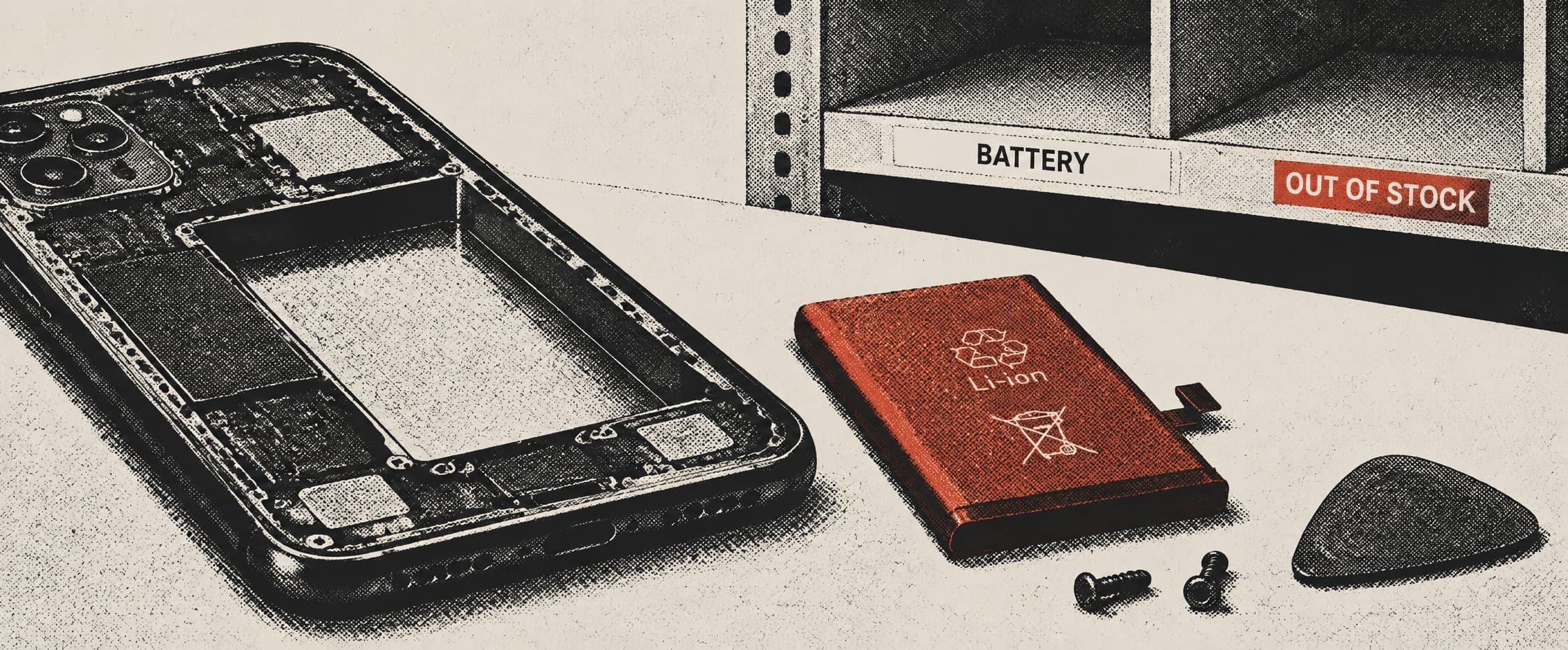
The battery has to come out in February 2027. Nothing says a replacement will be in stock.
Removability is decided, down to a ban on glue that needs a heat gun. Who holds spares, at what price and for how long is still being argued, and that is the half that decides year four.
The last time I opened a pair of wireless earbuds, the procedure was a heat mat, a scalpel, eleven minutes and an acetone-smelling residue that never quite came off my thumb. The cell inside was the size of a shirt button and cost about two euros as a raw part. The device it powered had lasted two years and eight months, which is roughly what that cell was good for, and there was no version of the afternoon that ended with it working again.
From February 2027 that procedure is supposed to be illegal to require.
What is actually decided
One sentence, and it is a clear one. A portable battery built into an appliance sold in the EU has to come out and go back in without specialist help: no tool that only the manufacturer has, no heat, no solvent, nothing but what a person could buy in a hardware shop.
That is the whole of the decided part, and it is genuinely decided — a date in a published regulation, not a launch window. Two screws and a plastic pick will comply. A pull tab might. A heat mat will not.
The interesting word is the one doing the load-bearing: readily. A ban on proprietary tools is checkable by a person holding a screwdriver. Readily is a judgement, and judgements get made in guidance documents that arrive late and get read by very few people. I have not seen final guidance and would not print a guess about where it lands. What I would say is that adhesive as such is not banned; adhesive that needs heat or a solvent is. Everything between those two things — the stretch-release strip that works four times in five, the foam pad that tears — is where the next eighteen months of argument sits.
There is also a derogation for appliances designed to work in wet conditions, which is the shape of every escape hatch ever drafted. I have not read its scope closely enough to say how wide it is, and its width is the difference between a rule about all appliances and a rule about most of them.
The hinge is not the cupboard
Here is the five-year problem, and it is not the one the rule addresses.
A battery you can remove in four minutes is worth exactly as much as the battery you can buy to put in. In year four, the questions that decide whether a device survives are: does a cell with the right chemistry, the right connector and a manufacture date this decade exist as an orderable part; what does it cost against the price of the whole device; and how long does it take to arrive. None of those three is settled by making the back come off.
Removability is a hinge. What decides year four is whether anything is in the cupboard.
Spare-parts duties do exist in the neighbourhood. The rules that landed on smartphones and tablets last year put manufacturers on the hook for holding parts, delivering them inside a stated window and supporting the software for a stated number of years, and they attach a repairability class to the label at the point of sale. Those rules are real and they bite. They also cover phones and tablets, and the battery rule covers the cordless vacuum, the shaver, the toothbrush, the handheld games console and the earbuds — a much longer list, answering to a much shorter set of obligations. The device with the strongest removability duty is frequently the device with no parts duty at all.
On price I have to be honest about a gap. Language about reasonable and non-discriminatory pricing turns up in ecodesign instruments, aimed at professional repairers. Whether anything equivalent reaches a battery sold across a counter to the person who owns the device, I could not establish. If it does not, the compliant outcome is a battery that comes out in four minutes and costs sixty per cent of a new appliance, which is a rule satisfied and a device thrown away.
What removability does create
An aftermarket, and quickly. The moment a cell is swappable by hand, third parties will make it, and the ones that fail an abuse test are the ones that will be cheapest. This is not an argument against the rule — it is the ordinary cost of a part becoming generic, and the same thing happened to laptop power supplies without civilisation ending. But a European battery aftermarket for two hundred device categories is a market-surveillance problem that nobody has resourced, and the failure mode is not a dead device. It is a fire in a kitchen drawer.
The check that works now
You do not need to wait for February 2027 to find out how a manufacturer intends to behave. Ask, before you buy, for the battery's part number, its counter price today and its quoted lead time. Then ask what that price was two years ago.
Three answers, one question. A manufacturer that can produce all three in an afternoon has an inventory system that knows about spares, which is the only evidence that means anything. A manufacturer that offers a service centre price instead has answered a different question, and the difference between those two answers is the difference between a device you can open and a device you can keep.
The date will not move; it has been in the text for years and the tooling decisions it forces were taken two product cycles ago. What is still open is the derogation list, what readily turns out to mean, and whether anybody is required to stock the part. On current reading, the answer to the third one is no.
Written from
Primary The document itself. Claims in this piece rest only on these.
- Placeholder: the EU batteries regulation, the article on removability and replaceability of portable batteriesThe instrument this piece rests on. I have not had the consolidated text open, which is why no article number is printed. Before publication, check four things: the application date used here (February 2027), the exact wording on commercially available tools, thermal energy and solvents, whether the duty runs to the end user or to an independent professional, and the precise scope of the derogation for appliances designed to operate in wet conditions.
- Placeholder: the ecodesign and energy labelling rules for smartphones and slate tabletsRelied on only for the existence of a spare-parts duty and an update duty in a neighbouring instrument, and for the fact that its device scope is narrower than the battery rule's. The number of years, the delivery window, the list of parts covered and the repairability class on the label all need checking against the text. Not opened for this piece.
- Placeholder: whether any price constraint attaches to a replacement battery sold to a consumerThis is the gap the piece turns on and I could not close it. Phrasing along the lines of a reasonable and non-discriminatory price appears in ecodesign instruments in relation to professional repairers. Whether anything equivalent reaches a battery sold over a counter to the person who owns the device, I could not establish. If it does, the section on price is wrong and needs rewriting rather than softening.
- Placeholder: manufacturer service documentation and published spare part pricesSource for the check described at the end. I have not compiled a price series across manufacturers and no vendor, model or figure appears here. Anyone running that comparison should record the part number, the counter price and the quoted lead time on the same day, because all three move.
Lead Pointed us at the story. Nothing here is cited as authority.
- Placeholder: trade coverage of the 2027 deadlinePointed at the story. Not cited and not relied on. No compliance claim, product plan or manufacturer statement from that coverage appears in this piece.